

What is a Grimoire?
Grimoire Girls: Part One

Welcome to part one of our series ‘Grimoire Girls’. To kick start this series of posts we’re going to be dissecting what we mean by ‘grimoire’. What exactly is one and how does it differ from other witchy paraphernalia, and why is it important for each witch to build one, in whatever shape or size.
Grimoire (Noun) /ˈɡrɪm.wɑːr/ or /ˈɡrɪm.wɑː/
A grimoire is a personal magickal encyclopedia, within its pages lie a myriad of spells, potion recipes, flora and fauna fact files, celestial workings, sigils, incantations and invocations. This is a powerful book of occult knowledge that is an extension of the witch and her system of beliefs, it is a magickal record of a witch’s craft, a sentient sidekick.
You may have heard of or even come across these types of books before, perhaps under a different name or guise. There are other names I would consider calling a grimoire, such as a spell book, an occult manual, an enchiridion, an esoteric handbook, but what I would not call it, is a Book of Shadows.
A Book of Shadows stems from a modern Wiccan tradition, in which you would write your innermost thoughts, feelings and findings. I use my book of shadows as a journal of my journey, a place to process emotions, reflect on dreams, or to delve deep into the realms of shadow work. The difference is stark, a Book of Shadows is a journal, a diary of sorts, and a Grimoire is a handbook, an encyclopeadia of your craft. A book of shadows is private, a grimoire can be shared and read by others.
The history surrounding Grimoires is a truly fascinating one, stemming from early Mesopotamia all the way up to modern day. Some grimoires are famous, some are still in tact, others remain only as torn sheets, as delicate as a moth’s wing. I will write a post on the history of grimoires one day, but for now… if you are curious, Owen Davies has a wonderful book out on the subject, called ‘Grimoires: A History of Magick Books’.
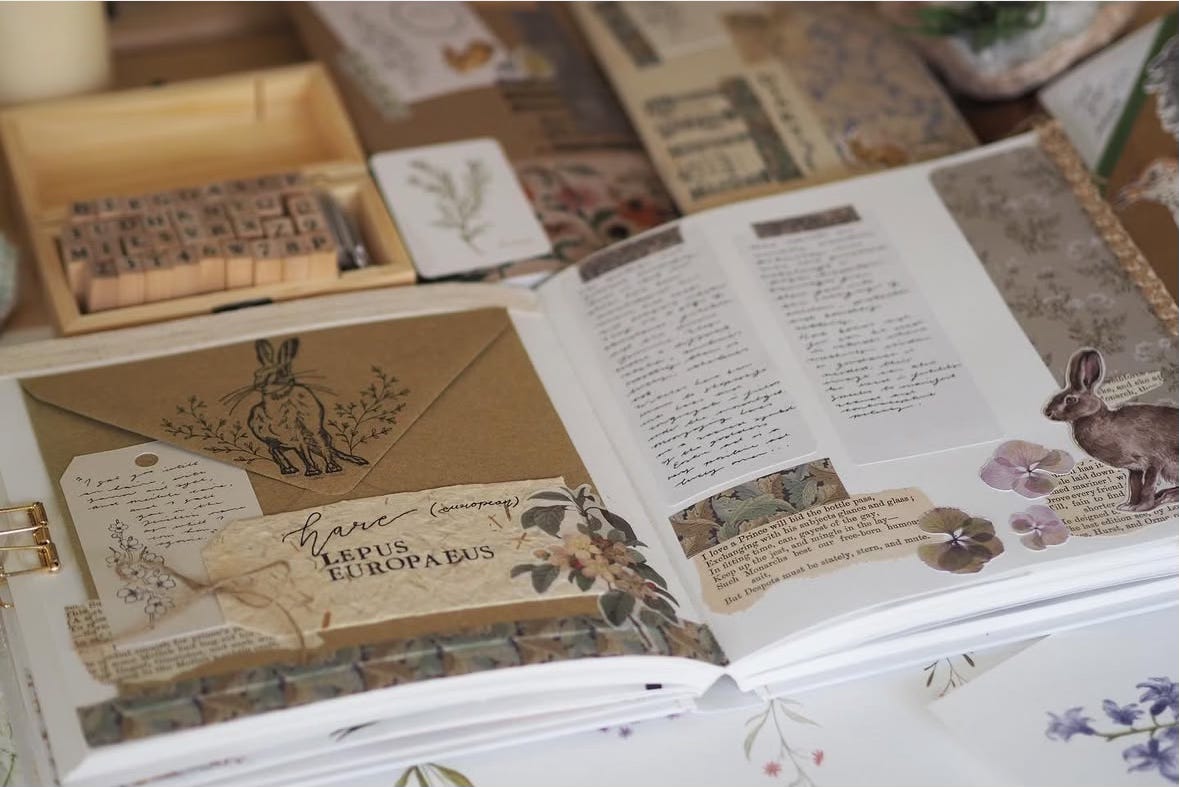
{This is the Grimoire I made to accompany my book ‘The Handmade Grimoire’. It was made from a very basic sketchbook that I picked up in Hobbycraft. I wanted to show that you could use the cheapest of materials to create a wonderful grimoire.}
Types of Grimoires:
Grimoires are as individual as those who create them. In my time researching and creating them I have come across ones so large that they encompass an entire table, and some so tiny, not much bigger than a fingernail. Some are digital, the entire magickal system of a person kept on a small flash drive, others are bound in vellum and written on onion skin paper, some are hastily scribbled pages in a cheap and unassuming notebook. The contents of a grimoire vary from book to book also, with some witches choosing to just covet one grimoire and keeping it forever, whereas others will have vast volumes of grimoires, and repurpose old ones.
This knowledge might seem overwhelming, so as we start to dip our toe in the rushing waters of grimoire creation know this… no one way is the right way. If you want your grimoire to be a beautiful leather bound tome, where you write only in the finest inks, that is wonderful. Similarly if you want to staple receipts together and scratch your spells in biro on the surface, that is also equally fantastic. Just the act of preserving your craft, of acknowledging and taking care of your hard work, is enough.
So… let’s take a look at what grimoires you might want to have a think about creating, what they’ll include, and their pros and cons.
The Grimoire:
A singular beast of a grimoire. This is the one and only grimoire that will contain all of your knowledge and findings. It’s a great method of magic-keeping for beginners, this is a grimoire that can be filled with your knowledge as you learn it, it will grow with you as a witch and as it fills so will your confidence in your craft.
Pros of a singular Grimoire:
Very handy to have. Everything is within reach, it’s in one place, you could even do an index so that you can easily skip to the pages you’d like to refer to or look back on.
You’ll grow a closer bond with just one book. Some believe (I certainly do) that as their grimoire grows and fills with your energy, that you become tied to it, that it becomes almost some sort of familiar. Having the book on your altar and having it be a part of spells and rituals etc, will strengthen it energetically.
It will be much easier to decorate, and use less supplies than it would do creating a series of grimoires. You can decorate uniformly, with each page matching and being cohesive in colour and style, or you can have each page being as starkly different to the next as you’d like.
Cons of a singular Grimoire:
You will have a finite amount of pages. At some point your journey with that grimoire will come to an end, you’ll have more to say and more to record and there won’t be any pages or room left to work with.
You will have limited space in which to work with, especially depending on the type of notebook. If you have an A5 journal you’ll find that a double spread may not be large enough for one entire topic, say moon magick for example. You could spread it out to have a double spread per moon phase, but before you know it you will have used a huge chunk of the notebook and not have much space for anything else.
Wear and tear. One of my first attempts to secure all my witchy knowledge into one book ended catastrophically. I bought a huge 300 (or perhaps it was 500, I don’t quite remember) A5 notebook with thin pages, and proceeded to decorate it the same way I would have decorated a scrapbook. By the time I was a third of the way through the book it was beginning to disintegrate. The spine was fraying and splitting, the pages were tearing with each turn, the whole book was groaning with ephemera, envelopes, and ink. I ended up delicately taking it apart and repurposing the pages in other grimoire ‘editions’.
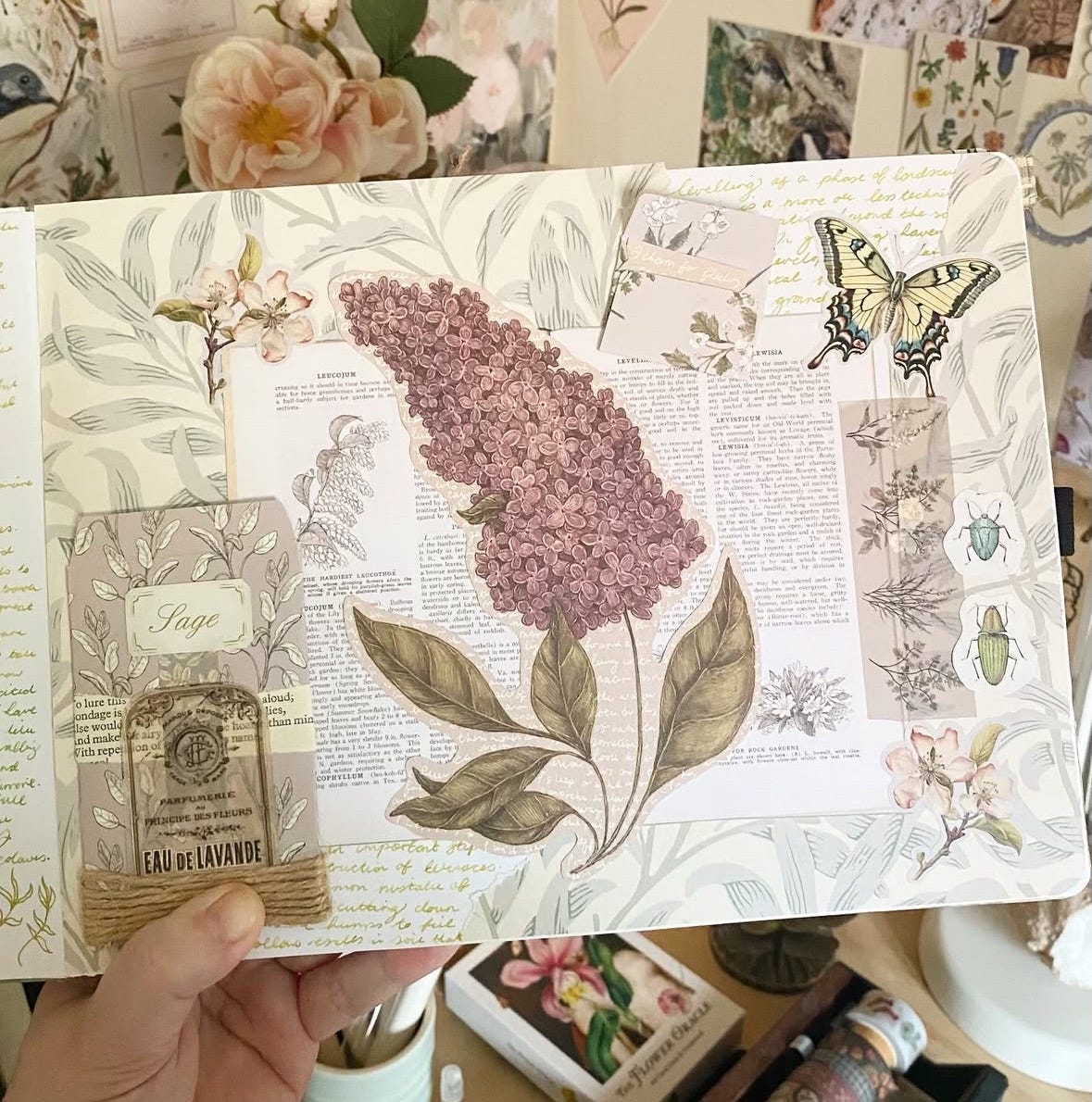
{This is from my latest grimoire, which is a large wedding guestbook style journal by Archer & Olive. I’m enjoying working with such a long landscape journal, but it is eating up a lot of my supplies!}
Grimoires in Volumes:
Either by genre, type, subject or purpose, having a series of grimoires to work on either all at once or one at a time is, in my opinion, a much better system to enjoy creating. There is no end goal to witchcraft, seemingly no end to the knowledge that is involved in this kind of lifestyle and purpose. You wouldn’t stifle yourself, so don’t stifle your record keeping either.
A series of grimoires could consist of just having multiple editions, each one not really about a specific subject, but more like writing one grimoire, coming to the end of the notebook and just continuing on and on, much the same as you would create and complete a yearly journal, or a scrapbook. Another idea is to split your grimoires in to subjects or genres, this is a great idea for those witches who tend to explore and examine lots of different parts of the craft, rather than focusing on one type of witchcraft that they identify with. These volumes could consist of grimoires dedicated to subjects such a celestial/astrological studies, green witchcraft, hedge witchery, spells for specific outcomes, potions, ingredients, and invocations.
Pros for multiple Grimoires:
More space to go really in-depth into a subject. You would have the space to really put as much information as possible into the pages, and the ability to be able to return and add more information or to log your findings or experiences.
Easy organisation and accessibility. If you were very organised you could write on the spines of your journals and notebooks so you knew what they contained, otherwise each volume would be arranged by subject, meaning that finding a spell, ingredient information, or insight into a subject would be much easier to locate than flipping through a singular grimoire.
The joy of creating. Being able to start a new project in a new journal is one of life’s little joys, and the ability to keep logging your experiences as you journey through your craft is a wonderful experience to have. Having so much of your craft written down is also useful for future witches, if you wish to leave them to someone when you pass, or for historians in the future to look back on and see what our modern day witches were up to.
Cons for multiple Grimoires:
Storage. If you are creating a new Grimoire every few months, the chances are your bookshelves are going to be very full after a couple of years. It might be worth investing in something like a Traveller’s Notebook, where you can change the thin notebooks out as you complete them, these are slim and take up very little space compared to a very large bullet journal for example.
Cost. The aim of Grimoire Girls is to keep your creating as cost effective as possible. I don’t want you to go out and spend £60 on a Traveller’s Notebook (yes, they really are that expensive) if you cannot afford it. I would much rather you shopped around and found some sort of system that was within your budget. Aesthetics and having the ‘right’ supplies is a discord I feel very strongly about, and will definitely be writing more about it later on in another post.
You should never feel pressured into buying things you do not need and will not use.Burn Out. This is something that needs to be discussed in many communities, but especially witchcraft. We can try so hard to make our craft perfect, but in doing so we can find ourselves shrinking and withering during the process. Creating a grimoire is supposed to be something that relaxes you, is meditative and restorative, it is not something that should drain you. If the thought of making ten different grimoires to cover all of your subjects fills you with dread, don’t do it, you have no obligation to. You create however much your brain and your schedule will allow you to, never feel like you are behind in anyway.
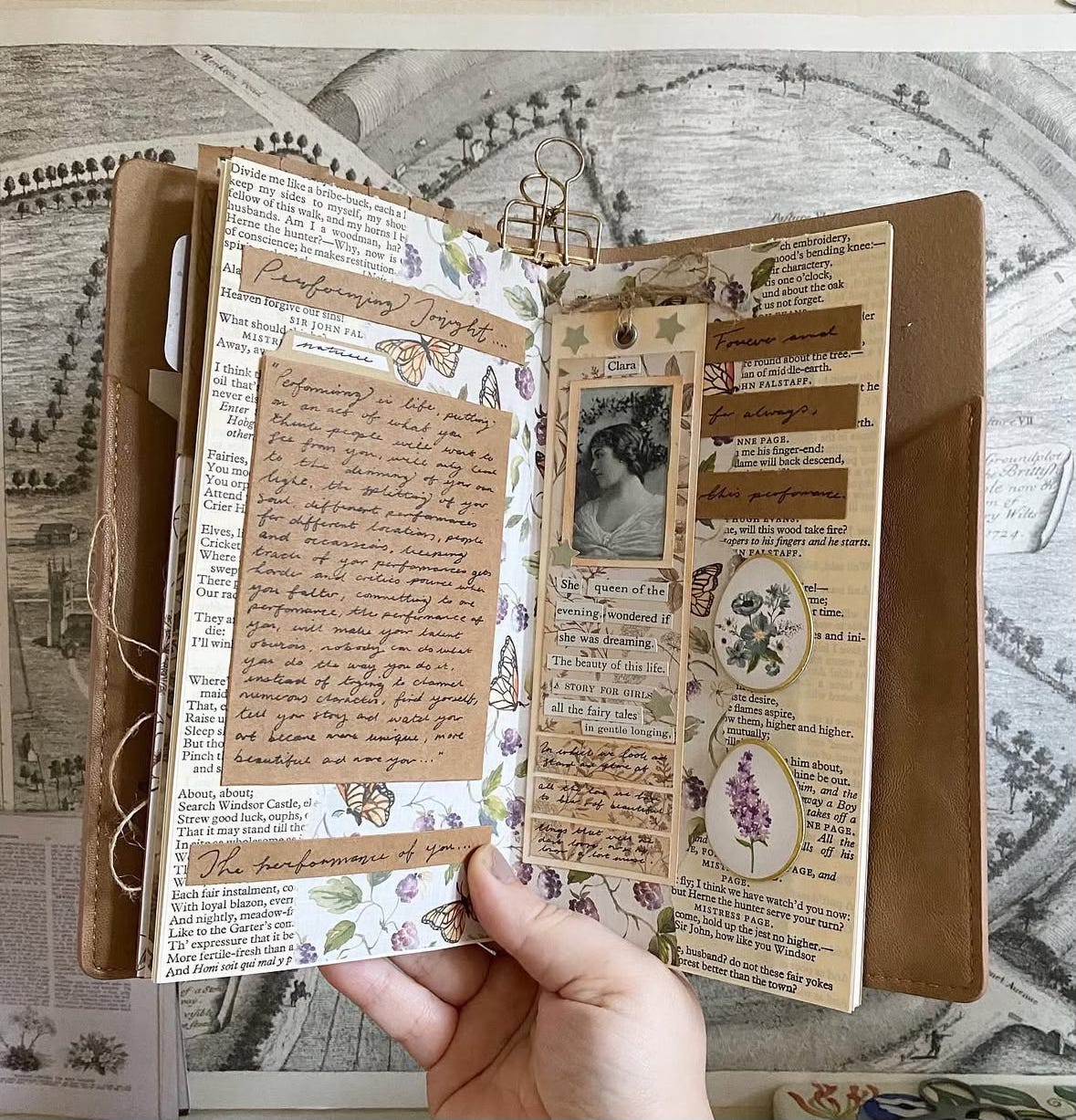
{This is the Hinoki traveller’s notebook by Notebook Therapy, I like that it is a leather-alternative to the traditional TN from the Traveller’s Company. Its a bit thicker, and won’t develop the lovely patina that natural leather does over time, but its very aesthetically pleasing.}
Recommended Vessels
I have tried an extensive amount of notebooks, journals, sketchbooks and scrapbooks over the past decade of my grimoire making, so I feel quite qualified to tell you which ones to use, and which to avoid. There are a few technical points to think about, which doesn’t sound very fun and whimsical but you’ll thank me later when you’re grimoire is holding up well whilst still being stuffed with magick.
Paper Thickness:
You may have seen bundles of paper, or notebooks, advertised with numbers next to them, followed by the words ‘GSM’. This is to notify you about the paper thickness, and which paper will be best suited for your project.
90-100gsm- This is standard writing paper, which will be great for those of you who want to just have a written grimoire, no stickers, no pressed flowers, no ribbons or anything fancy. If you are just wanting a notebook for writing and drawing, this is the best paper to look out for, you may find however that heavier inks bleed through, and glueing things in may tear the pages over time.
120gsm- You may have come across this paper in really good quality notebooks and bullet journals, such as Moleskine and Archer & Olive. This paper thickness tolerates heavier inks, a bit of paint to an extent, and also glued elements. The thicker paper means it will bulk up more quickly, so bear that in mind when you add elements and ephemera to the pages.
140-160gsm- We’re getting on the bulkier side now, and we’re looking at things like sketchbooks and thick journals. These are going to be great for bulkier elements such as ribbons, material, chipboard ephemera and photos, make sure you find a good glue to keep everything in place, as these papers will be able to tolerate it. They will also tolerate thicker paint such as gouache, and most alcohol based inks.
200-300gsm- This is Art Grimoire territory, if you aren’t looking to paint and use mixed media in your Grimoire then paper this thick is a bit of a waste. These sketchbooks will be very bulky, so would suit those who perhaps wanted to create a one off art grimoire rather than a written series. These papers are very durable so can take more liquids such as watercolours.
Notebooks & Journals*:
So many vessels! You may feel a little overwhelmed and spoilt for choice, but some journals are better than others, and thanks to my many many mistakes I can tell you which are worth investing your time, money and effort in…
*(I am note affiliated with any of these brands, and do not earn any commission for recommending them.)
Traveller’s Notebook:
Starting of with the most expensive to get it out of the way with… I LOVE my TN, I think the slim journals that you can take in and out of the leather wrap are a great way to fit as much information in as possible in a small space. The journals come in different paper thicknesses, there are some as thin as tracing paper which I would use for notes, and then there are thicker papers and watercolour ones which make for amazing nature journals. They are extremely portable, and look (and smell) amazing, but for me they are just a little bit too small for what I would call an ‘altar journal’, one that you would have out during a ritual.
Midori:
Very plain notebooks with very thin paper. I love them though as they fit really nicely into my Hobonichi planner covers. These don’t tolerate heavy inks or paints, but they are perfectly pocket sized for those of you who want to make lots of little subject-led grimoires.
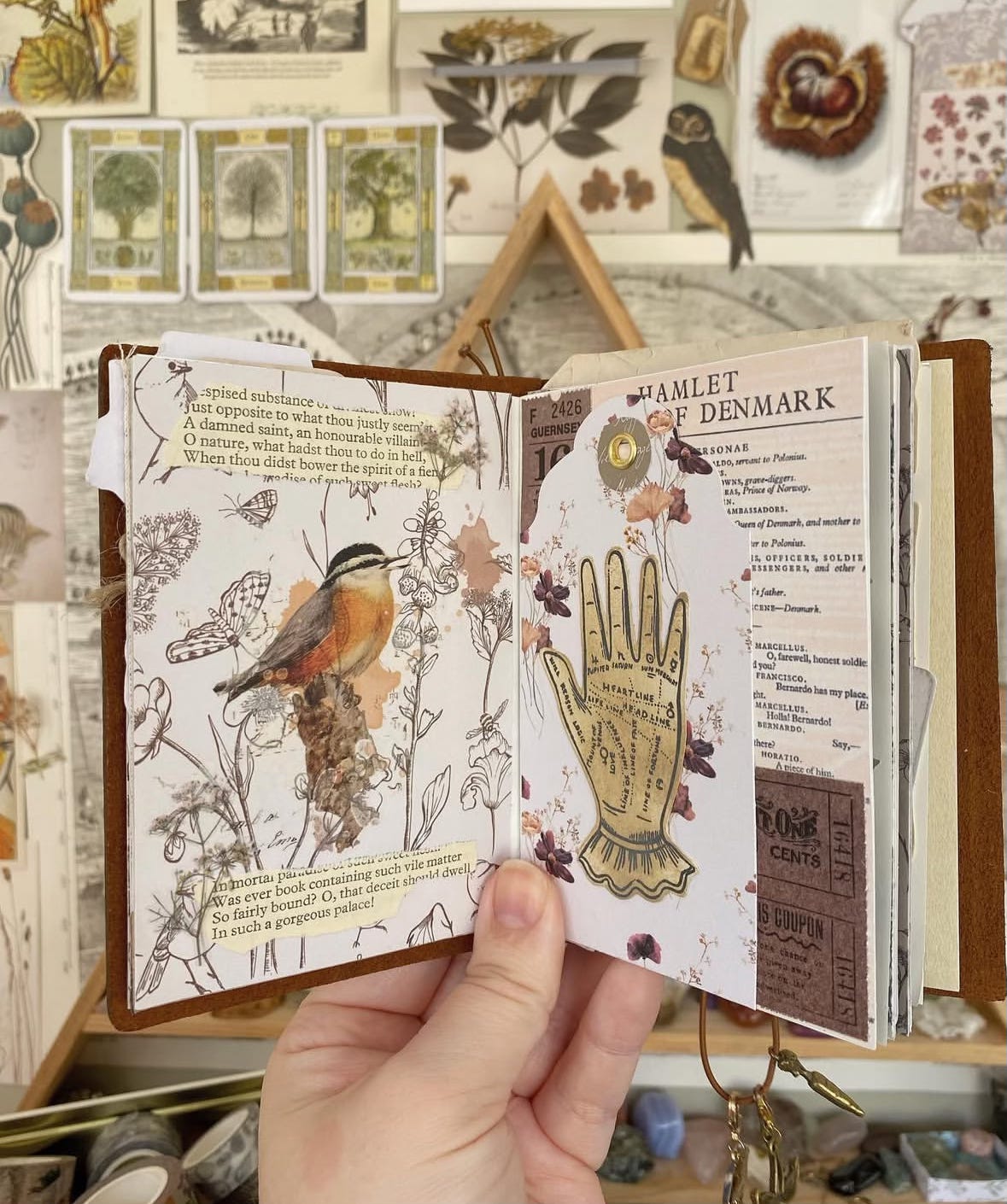
{This is the miniature passport sized version of the Traveller’s Notebook. Its very sweet, I like to add little flaps to hide information, to increase the amount of space that can be written on.}
Bullet Journals:
If you don’t mind the dot grid pattern (although some now come with plain paper) these colourful and pretty journals make for great compact grimoires. Thick paper, linen and shiny foiled covers will appeal to those who would like their grimoire to look nice sat on their altar. Brands I love are…
Archer & Olive:
This brand has such a huge array of notebooks out, and in different sizes from slim TN sized ones, A4, A5, and lovely square 8x8 ones which I tend to covet. The paper is lovely and thick and tolerates a lot being stuffed into it in terms of papers and envelopes.
Notebook Therapy:
A very similar brand but one that also does their own version of the Traveller’s Notebook, with faux leather wrap. Notebook Therapy tend to not have as many papers in as Archer & Olive, but they are much easier to get hold of for us Brits, and a bit cheaper.
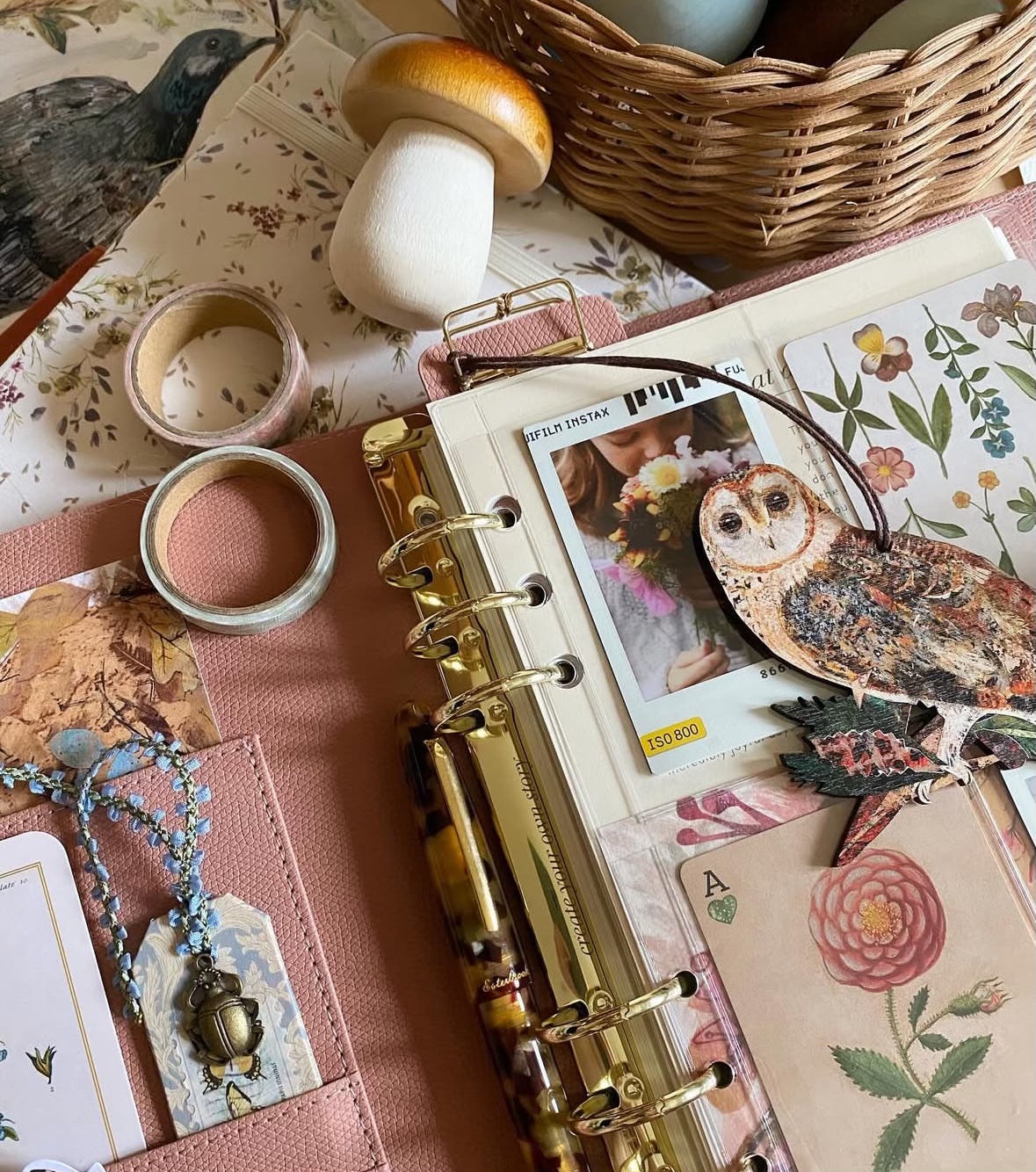
{This is an A5 binder from ‘The Inspired Stories’, usually used for daily planning inserts but I have repurposed it as a sort of grimoire junk journal… I enjoyed using it this year but chaos journalling, and chaos magick in general, is not my favourite. I’ll most likely repurpose it, that is the beauty of having a binder!}
Alternative Vessels:
One must never feel restricted to a hardback cover and neatly bound papers.
If you wish to create a different kind of grimoire please be my guest. I also have a very unaesthetic binder, which looks more like it belongs to a university student who is carrying it too and from lessons at the end of the year. If you would prefer to gather your contents and place them in a binder that’s a wonderful way to keep torn out pages, recipes, printed articles and scraps of paper neatly in one place. You might also decide that you would prefer more of a junk-journal approach to your grimoire creating, where you take your scrap papers, your sigils drawn on napkins, your rubbings of gravestones, and scrawled spells and staple them together in wads of chaotic magic. This is also potent, and defiant against those who would have you put them in a neat little notebook! Its not my style, but I admire the carefree attitude…
Whichever vessel you decide on, remember that it has to be practical as well as beautiful, and it has to keep you wanting to return to it. Grimoires are a wonderful addition to any witch’s toolkit, and as we move through this series we’ll look at more ways we can utilise them…
Next time, we’re going to look at what actually goes into the pages of a grimoire, the topics and subjects you might want to include, and how to actually start… what graces that first page?
Until next time,
Laura.
Did you enjoy this post? I’m keeping Grimore Girls free to access, but I have lots of amazingly insightful witchy posts that are tucked away for paying subscribers. If you’re able to, I would love to invite you to join The Bower Hare, I’m so grateful to anyone who chooses to support me in any way, and keep me writing about witchcraft…
Oooo, this was a lovely introduction to the Grimoire, Laura, thank you! I'm itching to get started, but battling with my OCD mind wanting the organisational benefits of a binder, with my creative side wanting a beautiful notebook with thick paper... I'll need to sleep on it!
My gosh I love this thread! Such beautiful work!!!